On the screen, the dryer timer flashes 1:12.
You sigh. The laundry basket is already filling up again, the kids are asking where their hoodies are, and your energy bill feels like a second rent. You open the dryer, grab a supposedly “dry” towel… and it’s still vaguely damp and warm. The laundry room smells like hot cotton and frustration.
You toss the clothes back in, add another 20 minutes, and do that little mental math no one likes to do: more minutes, more money, more time lost. As the drum starts spinning again, a question hangs in the air, almost ridiculous in its simplicity:
What if the secret to faster drying was… just one dry towel?
Why a single dry towel can change your whole laundry routine
The first time you hear it, the tip sounds like something from a relative who also swears by putting rice in salt shakers. “Throw a dry towel in with your wet clothes, it’ll go faster.” You raise an eyebrow. Then you try it once, half as a joke, and the dryer stops earlier than you expect.
The clothes feel lighter, less heavy with moisture. The jeans that usually take ages are already wearable. You check the timer, look at the clock, and there’s this tiny rush of satisfaction. Like hacking a boring chore you never thought could be improved. That’s when you realise this small gesture isn’t just a random trick. It changes the rhythm of your laundry days.
Picture a Sunday evening in a regular apartment block. Several machines humming on the same floor, people lining up with baskets and hampers. A young couple is sharing a dryer, stuffing in towels, t-shirts, and bedsheets. The guy hesitates, then tosses in a big, dry bath towel on top. “Saw this online, supposedly saves time,” he mumbles.
They come back earlier than usual. The cycle has already ended. The load is actually dry, not that annoying “almost there but not quite” stage. In shared laundry rooms, where everyone quietly times their turns, shaving 10–15 minutes off a cycle changes the social script. Less waiting. Fewer awkward hallway chats. And, in the background, a few euros or dollars quietly saved on every load.
On a basic level, the logic is simple. Your dryer works by circulating hot air, evaporating moisture, and pushing humid air out. When the drum is filled only with very wet textiles, the first part of the cycle is extremely inefficient. Everything is heavy, saturated, stuck together. The machine has to fight to move both air and fabric.
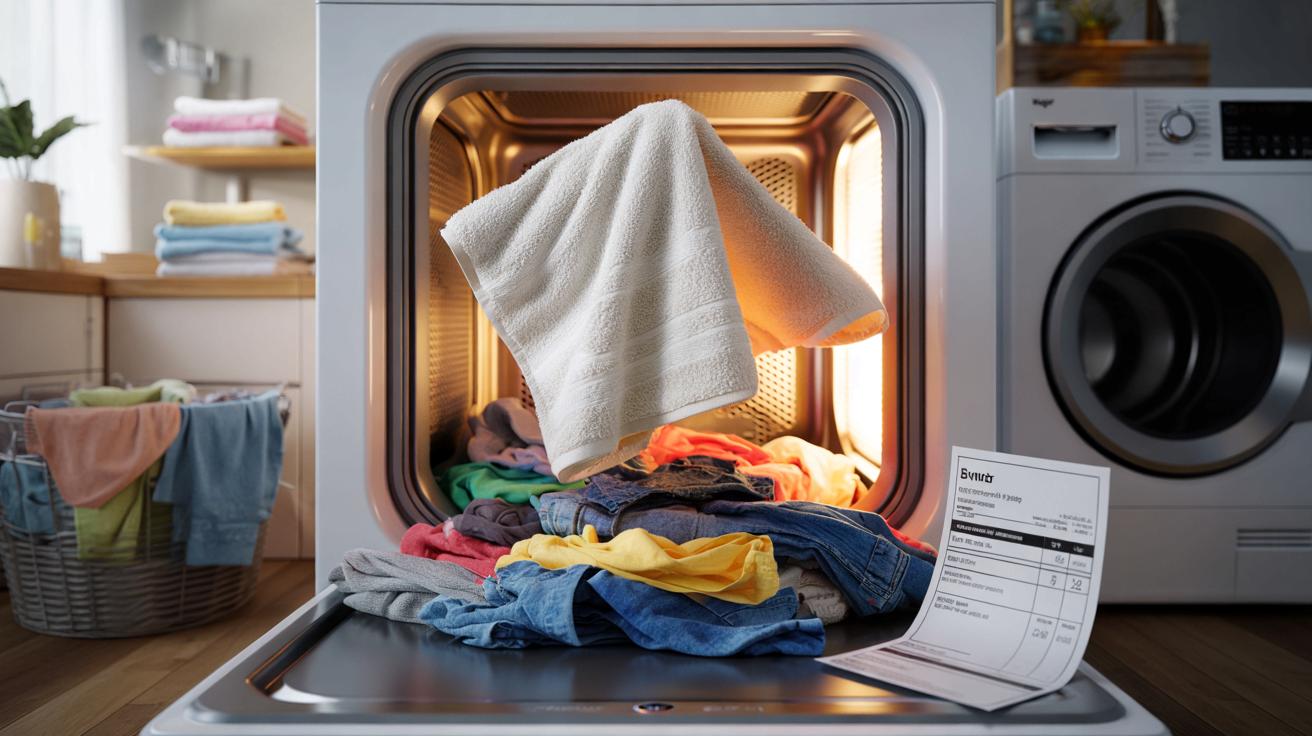
When you add a large, dry cotton towel, it acts like a sponge for moisture during those first critical minutes. It picks up water more quickly than hot air alone, reducing the overall humidity inside the drum. The clothes separate better, air circulates more easily, and the sensor (or timer) doesn’t need as long to reach the “dry enough” point. Logical, almost boring. Yet in the real world of busy evenings and high energy prices, that small gain becomes meaningful.
How to use the dry towel trick without wrecking your clothes
The method itself is almost disarmingly basic. Start your dryer load as usual: spin-dry your clothes properly in the washing machine, untangle the biggest knots, and avoid stuffing the drum until it’s packed solid. Then pick one large, clean, dry cotton towel. Not a microfibre, not a tiny hand towel. A real, absorbent bath towel.
➡️ Boiling lemon peel, cinnamon and ginger : why recommend it and what it’s for
➡️ I learned it at 60 : people know difference between white eggs and brown eggs
➡️ Emergency declared in Greenland as researchers spot orcas breaching close to melting ice shelves
➡️ Why wearing jeans in cold winter weather is discouraged "and what to wear instead to stay warm"
➡️ Skipping the gym for walking works "but only if you walk non-stop for 30 minutes at a 5 km/h pace"
Place it on top of the wet clothes when you load the dryer, or toss it in during the first 5 minutes of the cycle. Let the dryer run for 15–20 minutes with the dry towel inside. Then open the door, take that towel out – it’ll be noticeably damp – and continue drying the rest of the load. That’s the “classic” version of the trick: the towel gives an early boost, then gets out of the way.
Where people start to struggle is when they treat the dry towel like a magic wand. They throw one small towel in a huge king-size bedding load and expect miracles. Or they leave the dry towel inside for the entire cycle with delicate fabrics that don’t like friction. Some notice more creases or slightly rougher textures on light shirts and blame the tip itself, when it’s really a question of matching it to the right type of laundry.
Use this hack mainly for mixed cotton loads, sportswear, kids’ clothes, jeans, and towels. Avoid using it for lace, silk, or special-care items. And don’t rely on it to fix an overloaded drum that barely turns. Soyons honnêtes : personne ne fait vraiment ça tous les jours, mais quand you make the effort to sort and load properly, the towel trick suddenly looks a lot more impressive.
One home energy consultant I spoke to summed it up like this:
“A single dry towel won’t turn a bad dryer into a miracle machine, but in a normal home, with normal laundry habits, it can shave off enough minutes per load to feel real on the bill over a year.”
That’s the quiet beauty of this advice. It doesn’t require buying a gadget or downloading an app. It’s just using what you already own in a smarter order.
For those who like to visualise the gains, here’s a quick snapshot of how this plays out in everyday life:
- One dry towel can shorten a medium load by around 10–20 minutes, depending on your dryer.
- On a modern machine, that can mean several kilowatt-hours saved every month.
- Used over a year, the habit can offset a noticeable chunk of your laundry costs.
*Small acts in a repetitive chore quickly turn into quiet savings you barely notice at first.*
The deeper impact of shaving minutes off a boring chore
On paper, we’re talking about minutes. Fifteen here, ten there. In a spreadsheet, it doesn’t look like much. In real life, on a tired weeknight, those saved minutes feel different. That’s one less “I’ll switch the dryer later and forget until midnight” moment. One less load that has to be restarted because everything sat damp and wrinkled.
On a more emotional level, this kind of small optimisation gives you a sense of control over a chore that usually just feels like a background burden. You’re not changing your whole lifestyle, you’re not living by a strict “laundry routine” you saw on social media. You’re just learning a tiny trick that bends the process a little in your favour. On a planet where energy prices rise faster than salaries, that matters quietly.
This is the kind of tip people share at work over coffee, or slip into a conversation with a friend who just moved into their first place. It sounds almost too basic to be worth saying, yet once someone tries it and sees their dryer stopping earlier, they remember who told them. That’s often how change spreads in homes: not through expert manuals, but through these oddly specific, human little hacks passed from one person to another.
| Point clé | Détail | Intérêt pour le lecteur |
|---|---|---|
| Dry towel “boost” phase | Place one large dry cotton towel in the dryer for the first 15–20 minutes | Shortens early drying time and reduces overall cycle length |
| Remove towel mid-cycle | Take the now-damp towel out after the initial phase | Prevents overdrying, friction and unnecessary energy use |
| Best loads to target | Mixed cotton, sportswear, kids’ clothes, jeans and towels | Maximises time and cost savings on the most frequent laundry types |
FAQ :
- Does the dry towel trick really save money, or just time?Both. Shorter cycles mean the dryer’s heater runs for fewer minutes, which directly cuts energy use. Over dozens of loads, that adds up on your bill.
- Can I use more than one dry towel to speed things up even more?You can, but it’s usually not helpful. Too many towels crowd the drum, reduce airflow, and can actually slow drying or cause more wrinkles.
- Is this safe for all fabrics?No. It works best with cottons and everyday clothes. Avoid using it with delicate fabrics, wool, or items that already require gentle drying.
- What if my dryer is old and doesn’t have sensors?The trick still works. You’ll likely notice you can reduce your usual drying time by a small chunk and still get fully dry clothes.
- Can a dry towel replace a proper spin cycle in the washer?Not at all. A strong spin cycle in the washing machine is still the biggest energy saver. The dry towel is a bonus, not a substitute.