Once praised as “black gold,” the world’s richest soil is quietly becoming a weapon.
From the black earth of Ukraine to the vast wheat fields of Russia and Kazakhstan, fertile land now means power, leverage, and sometimes bloodshed. Farmers who once shared weather forecasts now trade accusations on Telegram. Borders that used to feel like lines on a map now cut through supply chains, friendships and families. What used to be about harvests is turning into a battle over who gets to feed — and charge — the world.
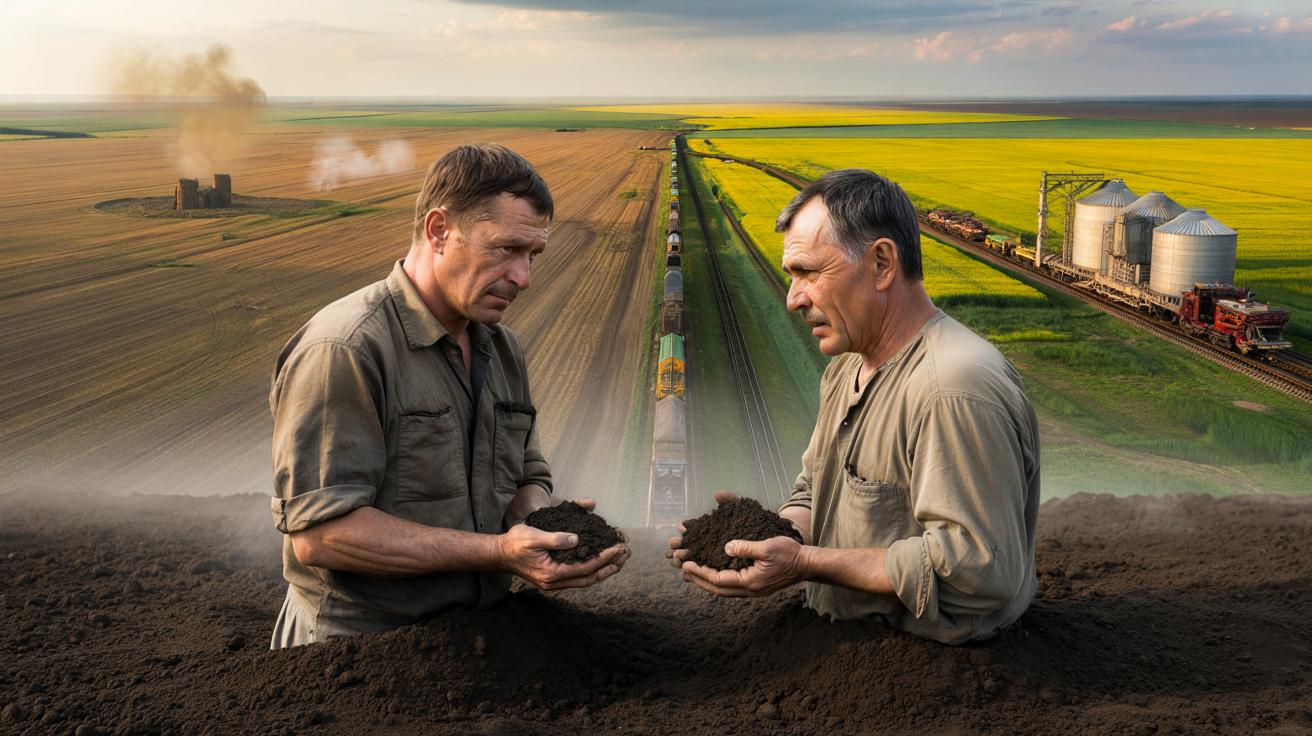
The wind hits hard on the open steppe, carrying the smell of wet earth and diesel. In central Ukraine, near Poltava, a farmer named Mykola kicks his boot into the soil and pulls up a handful so dark it almost looks fake. “This is what everyone wants,” he says quietly, crumbling it between his fingers. His land used to mean security, a future for his kids. Now it feels like a target drawn in brown and black. Some nights, when he scrolls through prices and war maps on his phone, the ground under his feet feels less like home and more like a battleground waiting to happen. Somewhere else, somebody is drawing a line through this same soil.
From “black gold” to pressure tool: when soil becomes a weapon
In Eastern Europe and Central Asia, soil has always been more than dirt. The so-called “chernozem belt” — the black earth stretching across Ukraine, parts of Russia, and northern Kazakhstan — is one of the most fertile regions on the planet. Farmers here joke that you could drop a nail and it would sprout. That dark soil helped build Soviet power, then fed half of Europe. Today, it underpins global wheat, corn, and sunflower markets. When those fields suffer, bread prices in Cairo, Lagos and Paris twitch. When they’re shut off, entire countries feel the pinch.
Since Russia’s full-scale invasion of Ukraine in 2022, this fertile strip has turned into a fault line. Ukraine, long called the “breadbasket of Europe,” saw huge parts of its farmland mined, shelled or occupied. Russian forces seized grain silos, re-routed exports, and pushed “legal” but highly contested grain into global markets. Kazakhstan, watching from the side, ramped up its role as a transit hub and exporter, while also facing pressure from both Moscow and Western partners. In this tangle, soil is not just a natural resource. It’s a bargaining chip in gas talks, sanctions battles, and backroom deals in distant capitals.
Seen from space, the black earth regions look calm: just big rectangles of brown and green. On the ground, the story is raw. Ukrainian farmers accuse Russian troops and allied companies of “stealing” their harvests — grain cut from occupied fields, shipped out through Crimea or Russian ports, and mixed into global supply. Russian officials swear they’re only exporting “legally acquired” crops from newly annexed territories. Kazakh exporters, squeezed between sanctions and Russian influence, quietly adjust routes, rename cargos, and rewrite origin labels. Fields that once competed only on yield now compete on narrative and legitimacy.
How control of soil shapes power, money, and everyday tension
Control of fertile land today means control of currency that doesn’t show up on your bank app. When Russia blocks or slows Ukrainian grain exports in the Black Sea, world prices jump. That spike hurts buyers in Africa and the Middle East, but it can benefit Russian and Kazakh exporters who still manage to ship. The same hectare of soil, in a war zone or in a “safe” country, no longer has the same value. Suddenly, geography becomes a market weapon, and a wheat field starts to look a lot like a gas pipeline: strategic, contested, political.
On the Ukrainian side, some farmers have turned into reluctant risk managers. One cooperative near Odesa now splits its crops, sending part by risky sea routes, part by rail through Poland and Romania, and storing the rest in improvised silos in case export corridors shut down again. Russian agribusiness giants, backed by state-connected banks, are meanwhile buying up or leasing huge tracts in regions considered more stable. In Kazakhstan, mid-sized farmers complain that land auctions feel tilted towards companies with better political connections and access to Russian or Chinese capital. You can almost see how the soil itself is being securitized, one deal at a time.
Behind satellite photos and export statistics sits something far more personal: trust. Farmers who used to share machinery across borders find themselves on opposite sides of sanctions lists. A Kazakh trader who once bought Ukrainian wheat and Russian fertilizers now spends half his week filling out compliance forms and the other half dodging angry calls about delayed shipments. Global grain companies tread carefully, caught between ethics, sanctions, and the raw fact that hungry cities need food. *Soil, once the symbol of quiet continuity, has become a source of permanent negotiation and sometimes open distrust.*
What this soil war changes for farmers — and why it should matter to you
On a very practical level, farmers are learning new survival tactics in a world where soil has turned political. In parts of Ukraine, some are switching to less input-intensive crops like sunflower or barley, in case fertilizer routes get cut again. Others are forming small cooperatives, pooling harvests to negotiate better freight terms or storage prices. Russian and Kazakh farmers, wary of sanctions or export bans, diversify too: more local processing of wheat into flour and pasta, so they’re not just stuck selling raw grain that might be blocked at a border. Strategy is no longer about the weather alone; it’s about anticipating the next diplomatic storm.
There’s also a quiet psychological shift, and it runs deep. On a wet spring morning in northern Kazakhstan, a young agronomist explains how his family used to dream only in yield numbers: 3 tons per hectare, then 4, then 5. Now, a different question lurks: “Will we even be allowed to sell this harvest where the prices make sense?” That nagging doubt changes how people see land. Instead of just a heritage to pass on, fields start to look like assets that might be expropriated, restricted, or stranded by sanctions. We’ve all lived that moment when something that felt safe — a job, a routine, a relationship — suddenly starts to feel fragile. Farmers are living that on the scale of entire landscapes.
➡️ Why wearing jeans in cold winter weather is discouraged "and what to wear instead to stay warm"
➡️ Emergency declared in Greenland as researchers spot orcas breaching close to melting ice shelves
➡️ I learned it at 60 : people know difference between white eggs and brown eggs
➡️ Skipping the gym for walking works "but only if you walk non-stop for 30 minutes at a 5 km/h pace"
➡️ Boiling lemon peel, cinnamon and ginger : why recommend it and what it’s for
➡️ Putting a dry towel into the dryer with your wet clothes can reduce the cycle time and save on costs
Cross-border resentment threads through conversations, even when people try to avoid politics. A Ukrainian grower curses “Russian grain dumped cheaply, because their state covers the costs.” A Russian producer snaps back that Western sanctions forced them to “find markets anywhere, anyhow.” Kazakh traders grumble that they are treated as a “back door” by everyone, squeezed from all sides. In this climate, small misunderstandings hit harder. Delayed payments feel like betrayal. A missed call becomes an insult. One exporter from the region summed it up simply in a late-night call:
“We’re no longer just competing with each other. We’re trapped in a game we didn’t design, on land that was supposed to feed us all.”
For anyone watching grain prices on their grocery receipt, this isn’t distant drama. It’s the backstory of your daily bread.
- Fertile soil is no longer only about food: it’s about sanctions, borders and leverage.
- Ukraine, Russia, and Kazakhstan sit on a shared treasure that now fuels political pressure.
- Every spike in grain prices often hides a battle over who controls this “black gold.”
What this “black gold” conflict reveals about our future
So where does this leave us, far from the steppe and its endless horizons? Start with a simple thought: each loaf of bread, bowl of noodles or bag of feed is tied to specific patches of earth that somebody is willing to fight over. Once you see that, supermarket shelves feel less neutral. The conflict over soil between Ukraine, Russia, and Kazakhstan is a warning signal about how climate stress, war, and geopolitics are fusing into one long, messy story. It’s less about one country being good or bad, more about what happens when basic resources become bargaining chips instead of shared foundations.
Soyons honnêtes : nobody checks where their flour really comes from every week. Most of us grab what’s affordable and move on. Yet when a war shuts a port, or sanctions bite into fertilizer supplies, the echo reaches your kitchen faster than you’d think. This isn’t meant to create guilt, just awareness. If fertile soil can become a weapon here, it can happen with water in another region, or with rare minerals under someone else’s feet. The hidden thread is the same: once a resource is scarce, or tightly controlled, the temptation to use it as leverage grows strong.
What’s striking in conversations with people on the ground is how torn they sound. A Ukrainian farmer can condemn the invasion and still miss the Russian colleague who once sent him spare tractor parts overnight. A Kazakh exporter might resent Moscow’s pressure and at the same time fear Western sanctions that could wreck his business. A Russian agronomist may dream of pure science and better yields while working in a system that uses harvests as geopolitical armor. Soil used to be what united them. Now, it’s also what divides them. That tension won’t vanish when the news cycle moves on, and it raises an uncomfortable question: how long can we keep treating the very ground that feeds us as just another tool in our power games?
| Point clé | Détail | Intérêt pour le lecteur |
|---|---|---|
| Soil as “black gold” | Ukraine, Russia and Kazakhstan share some of the world’s richest chernozem soils, crucial for global wheat, corn and sunflower markets. | Helps you see how distant fields shape the price and availability of your everyday food. |
| Geopolitics in the fields | War, sanctions and export routes have turned fertile land into a strategic asset and a lever in international negotiations. | Makes sense of headlines about grain deals, price spikes and food security fears. |
| Human cost and tension | Farmers and traders are pushed into rivalry and distrust, even when they once cooperated across borders. | Connects global conflicts to real lives, showing the emotional and social side behind statistics. |
FAQ :
- Why is this soil called “black gold”?Because the dark chernozem soils in Ukraine, Russia and Kazakhstan are extremely rich in organic matter, giving very high yields with relatively fewer inputs — a bit like oil once symbolised energy wealth, this soil symbolises food wealth.
- How did the war in Ukraine change grain markets?It disrupted planting and harvests, damaged fields, blocked ports, and made shipping dangerous or costly, which pushed up prices and shifted demand towards Russian and Kazakh exports.
- Is grain really being “stolen” from occupied areas?Ukrainian authorities and Western investigators say grain from occupied regions has been taken, re-routed through Russian-controlled ports and mixed into global exports; Russian officials dispute the term “stolen” and claim new ownership under annexation laws.
- Why is Kazakhstan involved in this tension?Kazakhstan sits in the same fertile belt, exports a lot of grain, and acts as a key transit route; it faces pressure from Russia, Western sanctions regimes, and its own need to keep trade flowing.
- What does all this change for ordinary consumers?You feel it mainly in food prices and availability: when these regions face war, sanctions or export limits, global grain supplies tighten and costs for bread, pasta, animal feed and cooking oil tend to rise.