The discovery hit me in the egg aisle of a suburban supermarket, under that buzzing neon light that makes everything look a bit too honest.
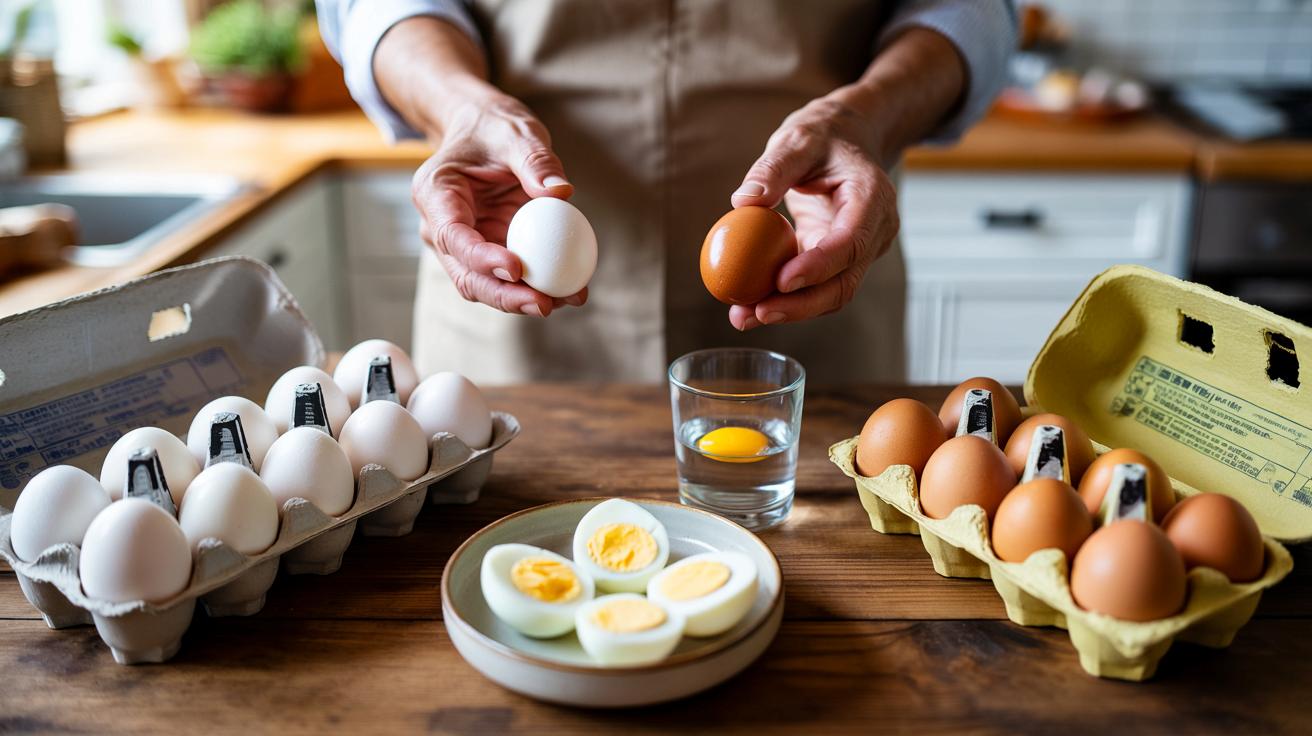
I was standing there, basket in hand, frozen between two shelves: white eggs on the left, brown eggs on the right. Sixty years old, three kids, thousands of breakfasts behind me… and I suddenly realised I had no real idea what made them different.
All those years I had paid a few extra cents for brown eggs because they “felt” healthier. More rustic. More “real”. Friends swore white eggs were for industrial kitchens, brown for families who care. The cashier glanced at my face as I hesitated, one carton in each hand, like I was choosing a political side. I went home that day with both boxes. And a question that wouldn’t let go.
What no one tells you about white and brown eggs
When I finally asked a farmer at the local market about it, he laughed so hard he almost dropped a tray. “You reached sixty to ask me that?” he said, wiping his hands on his apron. His answer was disarmingly simple: **the colour of the shell mostly comes down to the breed of the hen**. White-feathered hens with pale earlobes lay white eggs. Brown-feathered hens with darker earlobes lay brown eggs.
I stared at him like he’d just told me the sky was rented by the hour. The way we talk about eggs, you’d think brown ones were raised on poetry and white ones in concrete bunkers. In reality, the shell is just a kind of biological paint job. A detail of genetics that we turned into a story about health, class, and “real food”. That detail had been quietly deciding what ended up in my fridge for decades.
One evening, I tried a little experiment with friends during brunch. I boiled half a dozen white eggs and half a dozen brown ones, peeled them all, and mixed them in the same bowl. Nobody knew which was which. Everyone happily salted, sliced, ate. After a few minutes I asked them to guess which colour they had just eaten. The table went silent. Faces tensed like a quiz show finale. Answers flew: “Brown, for sure, tastes richer”, “Mine was white, it felt lighter”.
They were all guessing. Not one person could actually tell. I kept my poker face, but inside I felt slightly cheated by my own brain. We were tasting our expectations, not the food. Studies back this up: in blind tests, people usually fail to distinguish white from brown eggs by flavour alone. Yet supermarket sales data show entire countries preferring one colour over the other, as if it were a matter of national identity.
The real differences live elsewhere. What the hen eats changes the flavour and the colour of the yolk, not the shade of the shell itself. A hen roaming outside, nibbling grass and insects, produces eggs with deeper-coloured yolks and often a more complex taste. A hen in a tight indoor system, even if she lays a lovely brown egg, might give you something blander. The label “free-range”, “organic” or “barn” tells you more about your breakfast than the shell ever will.
Then comes price. Brown eggs are often a bit more expensive, so we assume they must be “better”. Yet that margin often reflects feed costs and logistics connected to certain breeds, not magical nutrients hiding in the pigmentation. There’s no built‑in vitamin bonus in the brown shell. *The myth is thicker than the egg itself.*
How to actually choose your eggs (beyond the shell)
Once you’ve swallowed the idea that colour doesn’t equal quality, the next step is almost freeing. You can walk down that supermarket aisle differently. Start with the small codes most people ignore. On many eggs, a number is printed directly on the shell: 0, 1, 2 or 3 in Europe, for example. That digit describes how the hen lived, from organic outdoor systems to crowded cages, no matter if the egg is white or brown.
Then look at the “best before” date and where the eggs come from. Freshness matters more than shell colour for texture, baking and poaching. Fresher eggs have tighter whites and proud, domed yolks. For poached eggs and soft‑boiled ones, that’s what you want. For meringues, a slightly older egg can even whip better. You start to build a small, practical relationship with what’s in the box, instead of a vague romance with its colour.
➡️ Skipping the gym for walking works "but only if you walk non-stop for 30 minutes at a 5 km/h pace"
➡️ Boiling lemon peel, cinnamon and ginger : why recommend it and what it’s for
➡️ Emergency declared in Greenland as researchers spot orcas breaching close to melting ice shelves
➡️ Putting a dry towel into the dryer with your wet clothes can reduce the cycle time and save on costs
➡️ Why wearing jeans in cold winter weather is discouraged "and what to wear instead to stay warm"
There are tiny home tests that feel almost like kitchen magic. Drop an egg gently into a glass of water. A very fresh egg sinks and lies flat. As it ages, air builds up inside and it starts to stand upright, then float. Colour plays no role in this little show. If you cook a lot, you’ll also notice that some eggs peel easier after boiling. That’s about age and cooking method, not whether the shell was white or brown on the shelf.
We rarely talk about the small anxieties that orbit around food choices. That moment at the checkout when you spot the person behind you with a carton that screams “ethical”, while yours looks plain and cheap. On a bad day, a box of brown eggs can feel like a moral badge. A box of white ones can whisper that you’ve “settled”. Soyons honnêtes : personne ne fait vraiment ça tous les jours, mais these stories sit quietly in the back of the mind when money is tight and labels are loud.
Marketing loves those stories. Darker colours, rustic fonts, little drawings of happy hens in the sunshine. Brown shells fit perfectly into that visual fairy tale of “farm fresh”. **That doesn’t make those eggs fake. It just means you can’t read a life story in the shade of a shell.** If all you can afford this week are the cheapest white eggs, you haven’t failed at caring. You’re navigating a system that mixes biology, branding and budgets.
“I’ve raised both white‑egg and brown‑egg hens,” a small‑scale farmer told me. “People lean over my stall and whisper like it’s a secret: ‘Brown is better, right?’ I tell them: ‘Better for what? Instagram?’ Then I talk about space, sunlight, and what the birds actually eat. That’s where the real difference is.”
To keep your thoughts clear in front of the shelf, it helps to have a tiny checklist in mind. Nothing heavy, nothing that turns every omelette into a moral debate. Just a few cues that bring you back to reality when your brain starts equating “darker shell” with “virtue”.
- Read the farming method code: it speaks louder than shell colour.
- Check freshness, not just brand design.
- If you can, prioritise how the hen lived over how the egg looks.
- Spend extra only when it changes farming, not just packaging.
- Remember: white vs brown is mostly a breed story, not a health story.
The small shock that changes how you see your kitchen
Once you’ve seen through the shell‑colour myth, it doesn’t stay neatly in the egg box. It creeps into other corners of the kitchen. You start asking why we link “wholemeal” with virtue and “white flour” with guilt, beyond the actual nutrition facts. You look at tomatoes, wondering how much of your loyalty is to taste, and how much is to the rich red that promises it. The grocery store becomes less of a stage set, more of a puzzle.
There’s a strange tenderness in realising how long you can carry a simple belief without questioning it. At sixty, you think your opinions about breakfast are locked in. Then a farmer at a market, or a half‑serious Google search, opens a crack. You remember that you’re still allowed to update your mental software about everyday things. It doesn’t make you naive. It makes you alive to your own habits.
That tiny shift can be contagious. People start confessing their own “I learned it at 60” moments. The friend who thought light olive oil had fewer calories. The neighbour convinced that sugar “melts” when baked and magically disappears. Every confession lifts a bit of pressure from the room. We’re not supposed to know everything about what we eat. We’re just trying to do a little better, one carton, one label, one breakfast at a time.
You might still choose brown eggs next week, out of habit or preference. Or white eggs because they’re cheaper and that matters more this month. Maybe you’ll mix both, just because you like how they look in the same bowl. The real difference now is not on your plate; it’s in your head. That soft, quiet awareness that colour is a story, not a verdict. And that story, at any age, is something you’re allowed to rewrite.
| Point clé | Détail | Intérêt pour le lecteur |
|---|---|---|
| Origine de la couleur | Le plumage et la race de la poule déterminent la couleur de la coquille | Comprendre que blanc ou brun ne dit rien, à lui seul, sur la qualité |
| Qualité réelle | Mode d’élevage, alimentation de la poule et fraîcheur changent le goût et la texture | Savoir où regarder sur l’étiquette pour faire un choix plus éclairé |
| Mythes marketing | Les œufs bruns sont perçus comme “plus sains”, alors que la coquille n’apporte pas d’atout nutritionnel | Éviter de payer plus cher uniquement pour une image ou une couleur |
FAQ :
- Are brown eggs healthier than white eggs?Nutrition is essentially the same; the hen’s diet and living conditions matter far more than shell colour.
- Why are brown eggs often more expensive?Certain brown‑egg‑laying breeds eat more or cost more to raise, and marketing reinforces the idea they’re “premium”.
- Do brown eggs taste better?Taste differences usually come from what the hen ate and how fresh the egg is, not the colour of the shell.
- Which eggs are best for baking?Use fresh, good‑quality eggs of any colour; recipe success depends more on freshness, size and temperature.
- How can I quickly judge egg quality in the store?Check the farming method code, the date, the condition of the shells and, when possible, buy from producers you trust.