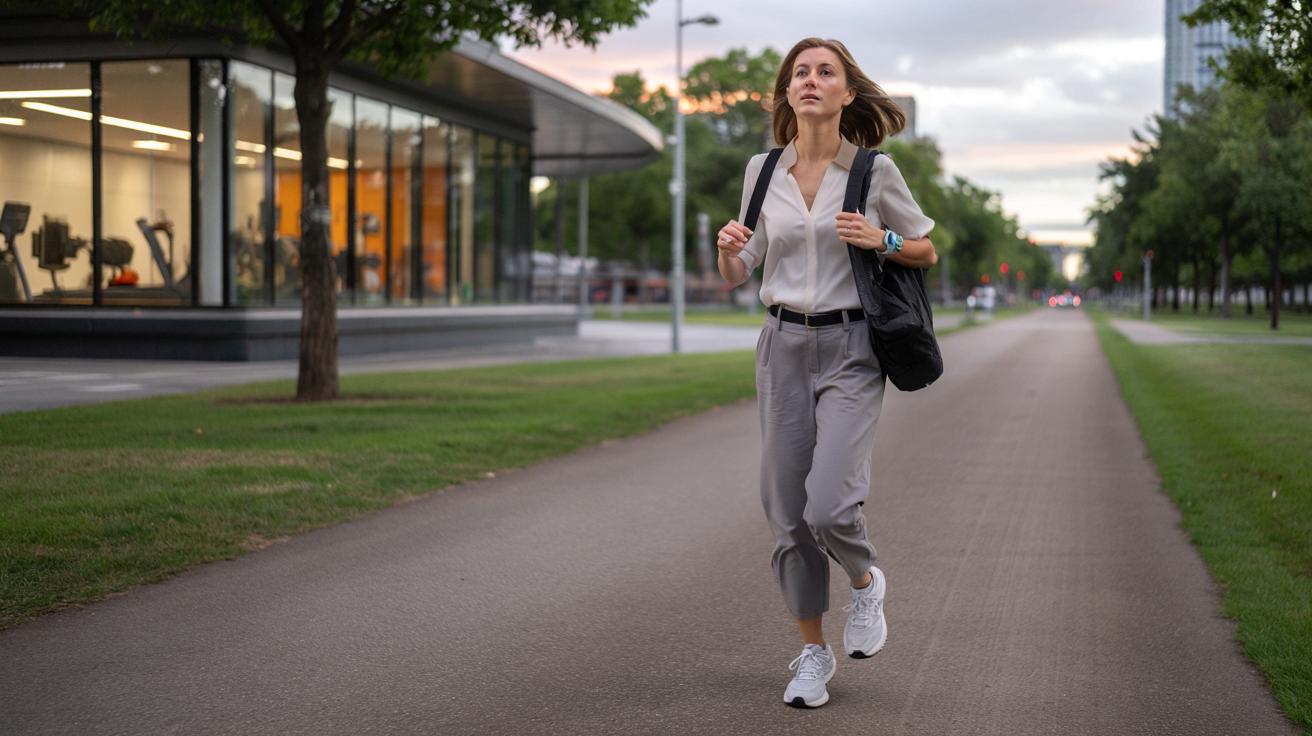
The woman in the blue blazer hesitates at the office door.
It’s 6:48 pm, gym bag hanging from her shoulder like a guilty secret. Outside, the sky is soft and pink, the pavement still warm. She looks at the bag. Then at the street. Then at the step counter on her phone.
Her gym is three metro stops away. The park is exactly at the end of the street. One choice smells like disinfectant and rubber mats. The other like cut grass and takeaway coffee.
She sighs, stuffs her gym card deeper into her pocket, and starts walking. Not strolling. Walking with intent. Head up, arms swinging, a little annoyed at herself, a little relieved too.
Ten minutes in, her breathing changes. Fifteen minutes in, her thoughts start to clear. By minute twenty, she’s wondering a quiet, slightly dangerous thing.
What if this… was actually enough?
Skipping the gym: does a 30‑minute walk really count?
Most people don’t skip the gym because they’re lazy. They skip it because life gets in the way. Commutes stretch, emails pile up, kids have homework, and suddenly that 90‑minute “gym session” (travel, changing, shower included) looks like a luxury trip.
That’s where walking sneaks in. It’s the only workout you can start in less than ten seconds, wearing whatever you already have on. No membership, no locker, no playlist calibration. Just you, your legs and a pavement that doesn’t close at 9 pm.
The question that nags at the back of your mind, though: if you ditch the weights and the machines for a brisk 30‑minute walk, are you actually doing your body a favour, or are you just giving yourself a polite excuse?
A study from the University of London followed adults who swapped structured workouts for brisk walking most days of the week. The rule was simple: walk non‑stop for at least 30 minutes at about 5 km/h. Heart health indicators improved, waistlines shrank a little, and mood scores shot up like they’d just discovered an extra day in the weekend.
Picture a 52‑year‑old accountant, Mark, who hadn’t seen the inside of a gym in three years. He started walking home from the train station, adding a longer loop around his neighbourhood. No equipment, no training plan, no Lycra. After three months of these evening walks, his blood pressure dropped enough for his doctor to raise an eyebrow and say, “Whatever you’re doing, keep doing it.”
➡️ Putting a dry towel into the dryer with your wet clothes can reduce the cycle time and save on costs
➡️ I learned it at 60 : people know difference between white eggs and brown eggs
➡️ Emergency declared in Greenland as researchers spot orcas breaching close to melting ice shelves
➡️ Boiling lemon peel, cinnamon and ginger : why recommend it and what it’s for
➡️ Why wearing jeans in cold winter weather is discouraged "and what to wear instead to stay warm"
That’s the kind of “quiet transformation” walking can trigger when it stops being an accident and becomes intentional. The trick is in those details people usually skip: continuous, daily‑ish, and at a pace that feels almost rude to your inner sloth.
The logic is less glamorous than a HIIT class, but brutally clear. Your heart and muscles respond to effort, not to marketing. A 5 km/h pace puts you roughly in moderate‑intensity territory: you can talk, but you can’t sing a whole song without pausing. Maintain that for 30 uninterrupted minutes, and you’re ticking the same cardiovascular box that many gym sessions aim at.
What walking won’t do alone is turn you into a powerlifter or a sprinter. It works best as a foundation: daily, repeatable, almost boring. Your circulation improves, your blood sugar behaves, your joints stay greased. Then, if you feel like adding bells and whistles later, your body’s already warmed up to the idea.
The real trade‑off is not “gym versus walk”, it’s “nothing versus something that fits your life so well you actually repeat it”. And that’s where walking quietly wins.
How to walk so your body thinks you went to the gym
To turn “just a walk” into a real workout, you need three things: pace, continuity, and a tiny bit of intention. The magic formula that keeps coming back in research is simple: 30 minutes, non‑stop, around 5 km/h.
What does 5 km/h feel like in real life? Imagine you’re late for a coffee date, but not late enough to run. Your arms swing naturally, your steps are a bit more decisive, and your breathing is deeper but nowhere near gasping. You could hold a conversation, but you’d rather keep sentences short.
Start by timing a known route. If you cover about 2.5 km in half an hour, you’re in the right zone. If not, gently nudge your pace up over a few days. Your body learns fast when you ask it clearly.
People love to log “10,000 steps” in scattered bits: elevator to desk, stroll to kitchen, quick loop around the block, slow supermarket aisle shuffle. It all counts for general activity, yes. But for cardiovascular benefit, these fragments don’t hit the same way as an unbroken, purposeful chunk.
The non‑stop part matters. Your heart needs time at that moderate effort to adapt, expand its stroke volume, and teach your blood vessels to relax. Think of it like simmering a sauce. Turn the heat on and off every two minutes, and nothing really blends.
That’s why one solid 30‑minute walk at 5 km/h will progress you more than twelve little 2‑minute errands, even if the step count ends up being similar. The body listens to the intensity and the continuity, not to round numbers on a bracelet.
People who fail with “walking as a workout” usually trip on the same hidden stones. They walk too slowly, they stop all the time, or they only go out when the weather and their calendar are perfectly aligned. Then they blame walking, when the real problem was the deal they had with themselves.
Soyons honnêtes : personne ne fait vraiment ça tous les jours. Life happens. Kids get sick, meetings explode, rain pours. The point isn’t perfection, it’s consistency that survives chaos. Four or five solid walks a week, at the right pace, will move the needle more than two flawless weeks followed by a month of nothing.
If your knees complain, choose flat routes, softer ground, or better shoes rather than giving up entirely. If your mind gets bored, change the scenery or the soundtrack. On a tough day, tell yourself, *“I’m just going for ten minutes.”* Half the time, you’ll end up doing your full thirty anyway.
“Walking is the closest thing we have to a universal movement language. Almost everyone can speak it. The question is: how often, how long, and with how much intention?”
On a practical level, it helps to turn your walk into an almost sacred appointment. Same time slot most days. Same rough route. Same “I’m not negotiating with myself for the next 30 minutes” energy.
- Pick a route of about 2.5 km you can do safely, without traffic stress.
- Use a simple app or watch once or twice a week to check you’re around 5 km/h.
- Walk non‑stop for 30 minutes: no calls, no scrolling, no shopping detours.
- Keep your posture tall, arms moving, and strides natural, not exaggerated.
- On busy days, split into 2 x 15 minutes at brisk pace rather than skipping entirely.
What walking gives you that the gym rarely does
There’s a quiet intimacy to walking that you rarely find between machines and mirrors. Your world shrinks to the sound of your footsteps, the rhythm of your breath, the tiny details you usually miss: a window you’ve never really looked at, a tree that somehow changed colour overnight, the dog that now expects you at the same corner every evening.
On a crowded day, that 30‑minute loop can feel like hitting a reset button in your chest. Not heroic, not dramatic, but surprisingly profound. Many people report that their moods lift long before their bodies visibly change. The walk becomes less about “burning calories” and more about “touching base” with themselves.
On a physical level, you’re stacking quiet wins: better blood flow, more stable blood sugar, joints that complain a little less the next morning. Emotionally, you’re wiring a new story: “I move, even when my day is a mess.” That identity shift is where many long‑term health changes secretly start.
Walking won’t replace every benefit of the gym. It won’t build big strength on its own, and it won’t get you ready for a marathon. What it can do is form a base layer that makes everything else more accessible. Stronger legs mean fewer excuses. Better sleep means more energy. Better mood means less all‑or‑nothing thinking.
We’ve all had that moment where we sat on the sofa, debated going to the gym for so long that the gyms actually closed, then went to bed vaguely annoyed with ourselves. A 30‑minute walk at a brisk pace cuts through that drama. You don’t need courage; you just need shoes and a door that opens.
If you start treating those walks as non‑negotiable health appointments, people around you might notice something else changing too. Not just your body, but your tone, your patience, your way of handling bad news. Quietly, day after day, that “simple walk” can start to look a lot like a life upgrade hiding in plain sight.
| Point clé | Détail | Intérêt pour le lecteur |
|---|---|---|
| 30 minutes non‑stop | Unbroken brisk walking rather than scattered steps | Maximises cardiovascular benefit in minimal time |
| Roughly 5 km/h pace | You can talk in short sentences, but not sing comfortably | Helps hit the “moderate intensity” zone without guesswork |
| Consistency over perfection | 4–5 walks a week beat rare, intense workouts | Makes a realistic, sustainable habit that fits busy lives |
FAQ :
- Does walking 30 minutes at 5 km/h really replace the gym?It can replace many cardio sessions if done regularly, but it doesn’t fully replace strength training. Think of it as a solid base, not the whole house.
- How do I know if I’m actually walking at 5 km/h?Use a GPS app once or twice to time a 2.5 km route in 30 minutes. After a week or two, you’ll recognise the feeling in your breathing and stride.
- Is it okay to split my walk into two 15‑minute sessions?Yes, especially on busy days. One continuous 30‑minute walk is ideal, but two brisk blocks are far better than giving up entirely.
- What if I already do strength training at the gym?Keep lifting if you enjoy it, and use walking as your daily movement “glue” between sessions. Your recovery, mood, and stamina will often improve.
- Can I count slow walks with friends or my dog?They’re great for your mind and general activity, but they usually don’t reach the 5 km/h pace. Keep them, and add a separate, purposeful brisk walk when you can.