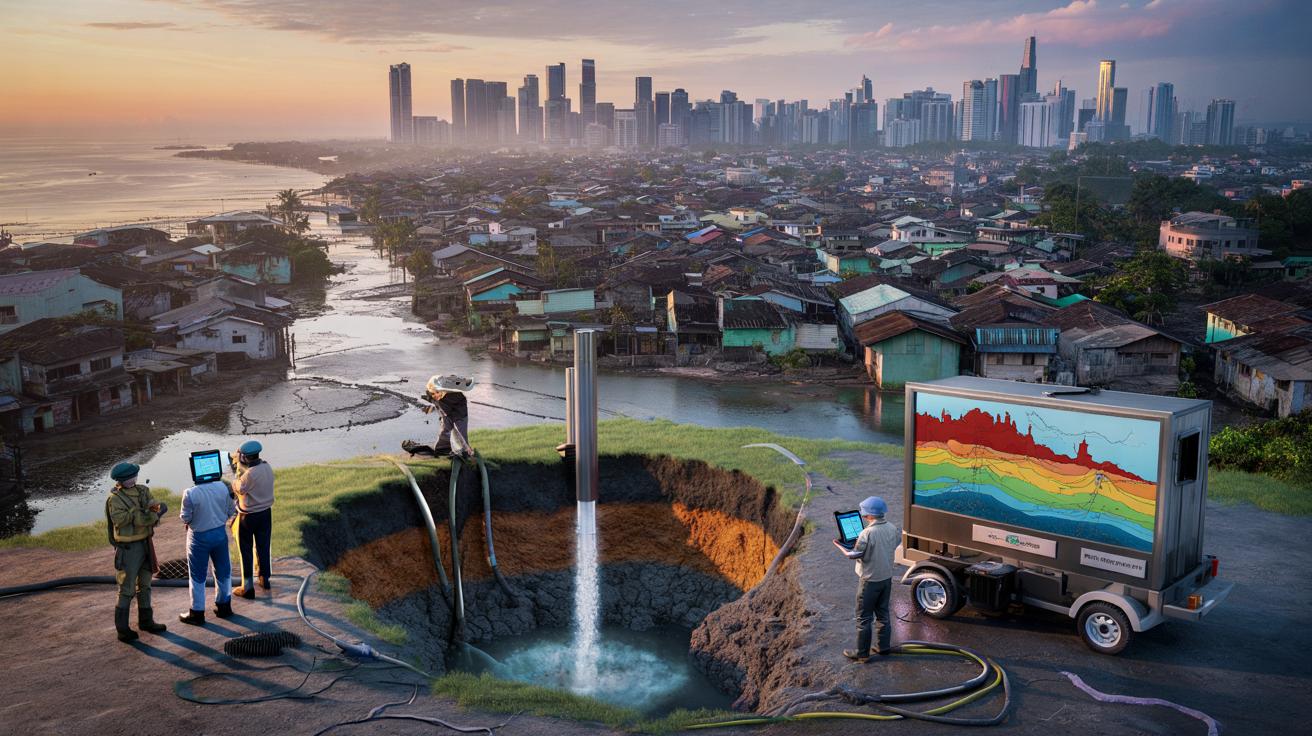
The engineer in the orange vest stops talking when the ground monitor beeps.
Behind him, Jakarta’s skyline wavers in the haze, glass towers rising above a sea of corrugated roofs and satellite dishes. At his feet, a metal probe disappears into the soil where a fishing village once stood on higher land. Now, it floods twice a month.
He points to an old map, its paper soft and almost translucent. The coastline drawn in blue is a full kilometre from where the water actually laps today. “The city is sinking,” he says quietly, as if naming a family secret. Then he walks over to a pipe where water hums underground, vanishing into an oil reservoir no one can see.
What used to be the problem—oil extraction—is now being turned into the bandage.
When the ground starts to fold under our feet
On satellite images, subsiding cities look tired. Streets kink a little. Drainage lines warp. In places like Mexico City, Shanghai or Jakarta, the land doesn’t collapse in one dramatic moment, it just slowly exhales and never breathes back in.
Engineers call it land subsidence; residents call it broken pipes, cracked walls, and floors that suddenly tilt. A few millimetres a year doesn’t sound like much. Over a decade, that’s the difference between a dry living room and saltwater licking your doorstep at high tide.
In former oil fields beneath some of these cities, rock layers behave like a squeezed sponge. For decades, we pulled out oil, gas, and water, reducing the internal pressure that held everything up. Now, as climate change pushes seas higher and storms stronger, that missing pressure has become painfully visible in sunken neighbourhoods and flooded highways.
In the flat outskirts of Shanghai, the story is written in bricks and doors. Locals still remember when engineers started measuring subsidence in the 1950s: some districts were dropping by more than 10 centimetres a year. By the 1960s and 70s, tall buildings leaned just enough to make you dizzy if you stared too long.
Then the city did something radical for its time. It launched strict controls on groundwater pumping and began injecting treated water back into deep aquifers and depleted oil-bearing formations. The result wasn’t instant, but it was visible on paper. Those scary downward curves on monitoring charts bent and flattened.
In Indonesia, the experiments are newer and more frantic. Near Jakarta, where entire neighbourhoods sink by up to 25 centimetres a year, test projects now pump water into exhausted oil reservoirs offshore to keep seafloor and coastal zones from sagging faster. It’s a strange reversal: old wells that once brought up fossil fuels are being repurposed as valves for survival.
Geologically, the logic is disarmingly simple. Under a city, the subsurface looks like a layered cake of sands, clays, and rock. Oil and groundwater once sat in the pores between those grains, propping them apart with pressure. Remove too much fluid and the grains rearrange, closer and tighter. The surface above loses a tiny bit of height every time that happens.
➡️ Emergency declared in Greenland as researchers spot orcas breaching close to melting ice shelves
➡️ Putting a dry towel into the dryer with your wet clothes can reduce the cycle time and save on costs
➡️ I learned it at 60 : people know difference between white eggs and brown eggs
➡️ Skipping the gym for walking works "but only if you walk non-stop for 30 minutes at a 5 km/h pace"
➡️ Why wearing jeans in cold winter weather is discouraged "and what to wear instead to stay warm"
➡️ Boiling lemon peel, cinnamon and ginger : why recommend it and what it’s for
By pumping water back into empty oil fields or depleted aquifers, engineers try to replace some of that lost pressure. It doesn’t rebuild the cake. It slows the crushing. *Think of it less as lifting a city up, and more as putting a hand out to steady it on the way down.*
The method isn’t a magic reset. Rocks can behave plastically; once they compact, some of the damage is baked in. But carefully managed injection—at the right depth, at the right rate, with relentless monitoring—can turn a runaway collapse into a modest, manageable sag. In the age of rising seas, that extra time is priceless.
How to push back, centimetre by centimetre
The core “trick” sounds almost too straightforward: take water you don’t want at the surface—treated wastewater, stormwater, sometimes desalinated seawater—and send it down into the subsurface where oil once pooled. The engineering, of course, is anything but simple.
Teams start with detailed 3D models of the underground reservoir. They map every fault, every fracture, every old well that could leak. Then they choose injection points and install wells that can survive pressure that would burst ordinary pipes. Pumps push water into the porous rock, while sensors track how the land responds millimetre by millimetre.
On a screen in a control room, the city appears as a colour map: blue for stable zones, orange for sinking, red for hotspots where buildings feel the strain. Every change in injection rate nudges those colours. It feels less like operating a machine and more like gently negotiating with a restless giant.
Urban planners love to talk about big visions: smart cities, green roofs, bold architecture. Underground, the work is slower and less glamorous. Engineers in places like Houston or Venice know the drill: keep an eye on well logs, keep the injection volumes within safe limits, keep adjusting to what the geology actually does, not what the computer promised.
Where projects stumble, it’s often not the science, but human habits. Cities drag their feet on regulating groundwater pumping. Industries resist paying to switch to surface water. Politicians prefer cutting ribbons on visible projects instead of quietly funding monitoring stations in anonymous fields.
Soyons honnêtes : personne ne fait vraiment ça tous les jours. No city wakes up excited to re-pressurise exhausted oil reservoirs. It’s expensive, slow, and sometimes controversial. Yet the alternative is watching roads crack and metro tunnels take on water. So the pioneers—Mexico City with its aquifer recharge, Shanghai with its strict pumping rules, parts of California’s Central Valley—keep experimenting, knowing others are quietly watching.
“You can’t negotiate with gravity,” says a hydrogeologist in Jakarta. “You can only change the terms of the fall.”
That kind of brutal clarity has reshaped how some engineers think about “saving” a city. The goal is not perfection, it’s buying time. More years for sea walls to be built. More time for people to move out of the most vulnerable zones. More time to rethink how a metropolis drinks, drains, and builds.
- Limit uncontrolled groundwater and oil extraction in urban zones sitting on soft sediments.
- Use depleted oil and gas reservoirs as controlled “pressure banks” with monitored water injection.
- Invest in dense networks of subsidence sensors to spot dangerous trends early.
On a personal level, the story also hits home. On a quiet day, standing on a street you’ve known since childhood, it’s unnerving to learn that the ground beneath you is literally lower than it was when you were born. We’ve all experienced that moment when a familiar place suddenly feels fragile, and you can’t unsee it.
The uneasy future of cities that float on rock and water
Once you know that many modern cities are effectively sitting on giant sponges—sediments held in shape by water and old oil—the news reads differently. A “once-in-a-century” flood becomes more than a freak event; it’s what happens when sinking land and rising seas finally meet in the same unlucky year.
Re-pressurising empty oil fields will not rescue every coastal metropolis. In some places, the rock is too fractured. In others, the compaction is already locked in. There are also risks: inject too hard and you can trigger small earthquakes or push contaminants into clean aquifers. This is delicate surgery, not a quick patch.
Still, the idea that the same wells that fueled the 20th century might help some cities survive the 21st has a strange, circular poetry. As we talk about phasing out fossil fuels, those old reservoirs may stick around not as cash machines, but as quiet guardians against collapse. It’s a reminder that our relationship with the underground doesn’t end when the last barrel is sold.
For readers far from Jakarta or Mexico City, this can feel abstract, like someone else’s disaster. Yet maps of subsidence now show worrying patches under parts of London, San Jose, Bangkok, Tehran, even small towns that pumped too much groundwater for too long. The line between “solid ground” and “slowly sinking” is thinner than we like to admit.
Maybe that’s the most unsettling part: this isn’t a Hollywood earthquake or a sudden sinkhole. It’s the quiet, bureaucratic kind of crisis, measured in spreadsheets and tiny shifts on a sensor. A centimetre here, a cracked schoolyard there, an old warehouse that now floods in storms it used to shrug off. The future of some of the world’s biggest cities may depend on how fast we learn to listen to what the ground is saying.
| Point clé | Détail | Intérêt pour le lecteur |
|---|---|---|
| Land subsidence is accelerating in many cities | Excessive extraction of oil, gas and groundwater has lowered underground pressure, causing the ground to compact and sink | Helps you understand why floods and cracks are becoming more common where you live or travel |
| Water injection into depleted oil fields can slow the sinking | Engineers pump treated water into old reservoirs to partially restore pressure and stabilise the surface | Shows that there are concrete, technical ways to delay damage while larger climate solutions catch up |
| The approach buys time, not a miracle cure | Compaction is partly irreversible and poorly managed injection can create new risks | Invites a realistic view: this is a tool in a broader strategy, not a magic fix |
FAQ :
- Is pumping water into empty oil fields really safe for cities?When designed well, with strict monitoring of pressure and seismic activity, it can be relatively safe and very effective at reducing subsidence rates. The danger usually comes from cutting corners, not from the basic principle itself.
- Can this actually lift a sinking city back up?In most cases, no. The aim is to slow or stabilise the sinking, not to reverse it completely. Once certain rock layers compact, that lost height is mostly gone for good.
- Will this solve flooding caused by climate change?It can reduce how quickly land drops, which helps against coastal flooding and storm surges, but it doesn’t stop sea level rise. It has to go hand in hand with better drainage, sea walls, and smarter urban planning.
- Does using wastewater underground contaminate drinking water?Projects use treated water and inject it into deep layers separated from drinking aquifers by impermeable rock. Done properly, those barriers keep contaminants away from the water we use at the surface.
- Why not just stop extracting oil and groundwater instead?Many cities are trying, by shifting to surface water and regulating wells. Yet the damage from past extraction is already there. Re-pressurising old reservoirs is about managing that legacy while we change how we use resources today.